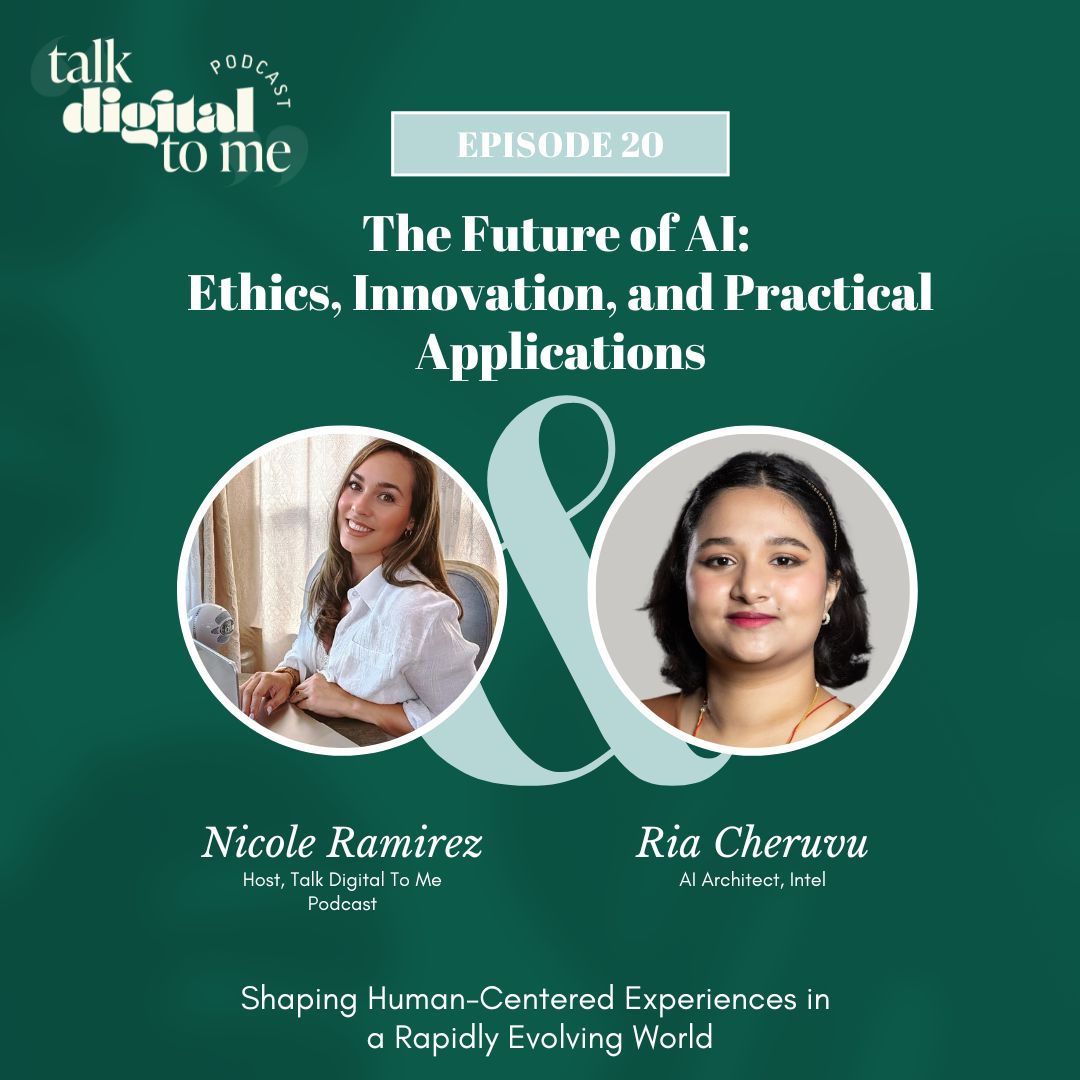
Listen to the podcast:
Below are key insights and actionable takeaways from our conversation.
Key Takeaways
AI’s Practical Impact on Everyday Life
AI is becoming an indispensable tool for personal productivity and business efficiency. Ria highlighted some of its most impactful applications:
- Optimizing daily tasks such as smart assistants and automated scheduling.
- Enhancing robotics to assist with caregiving and household chores.
- Streamlining writing, research, and communication through personalized automation.
The Ethical AI Movement
AI is only as unbiased as the people building it. Ria emphasized the role of diverse perspectives in ensuring fairness, sustainability, and inclusion in AI development.
Key considerations for ethical AI:
- Data privacy and transparency
- Inclusive representation in AI models
- Safeguards against bias and misinformation
AI and Philosophy: Can Machines Truly Empathize?
As AI becomes more advanced, it raises philosophical questions about intelligence and human-like behavior.
- Can AI truly understand emotions, or is it simply recognizing patterns?
- What does it mean when we say AI can empathize?
- How do we ensure AI aligns with human values while maintaining accountability?
Starting a Career in AI
For those interested in AI, Ria suggests focusing on real-world problems rather than just learning the technical aspects.
- Identify a challenge that interests you and use AI to solve it.
- Leverage open-source communities for collaboration and learning.
- Experiment with small projects before scaling up.
Open Source Communities and AI Innovation
Ria strongly advocates for the power of open-source communities in driving AI forward.
- Open collaboration accelerates innovation.
- If a solution does not exist, create it.
- Open-source projects are often the starting point for groundbreaking AI advancements.
Women in AI and Tech
Ria emphasized the importance of mentorship and community in fostering inclusivity in the AI industry.
- Representation matters in shaping ethical and responsible AI.
- Support networks help women in tech push boundaries and advance their careers.
- AI and STEM fields must actively create space for diverse voices.
AI and Behavioral Economics
One of the most thought-provoking discussions was about AI’s influence on human behavior.
- How do we use AI to encourage positive habits?
- Can AI avoid creating echo chambers that reinforce biases?
- How do we strike a balance between nudging and over-personalization?
The Future of AI
Looking ahead, Ria sees AI continuing to shape the world in ways we are only beginning to understand.
- AI will continue to drive human-centered experiences.
- The intersection of AI and robotics will bring new solutions for healthcare, automation, and everyday life.
- Ethical challenges will remain at the forefront, requiring continuous dialogue and innovation.
Quotes from Ria Cheruvu
On AI’s Practicality
“AI is transforming daily tasks, from optimizing apps to helping clean your house. It’s about making technology practical and purpose-driven.”
On Ethical AI
“The next generation is key to ethical AI innovation, bringing diverse perspectives to shape fairness, sustainability, and inclusion.”
On Getting Started in AI
“Start with a problem that fascinates you. Curiosity wins the day in AI.”
On the Role of Philosophy in AI
“When we say AI can empathize, what does that really mean? It raises profound questions about consciousness and human-like intelligence.”
On AI’s Potential
“Human-centered experiences are the future of AI—whether it’s a robot that can care for the elderly or one that helps with everyday tasks like cooking.”
On Challenges in AI
“One of the biggest challenges in AI is teaching it to perform tasks that come naturally to humans, like stacking blocks—things we take for granted.”
On Open Source Communities
“If you don’t see it out there, create it. Open-source communities are where innovation begins.”
On Women in Tech
“Mentorship and community are the most rewarding parts of being a woman in tech. It’s about challenging yourself and finding spaces that push you to grow.”
On AI and Behavioral Economics
“How do we nudge people towards good habits using AI while avoiding the trap of creating bubbles that reinforce their biases?”
On Future Innovation
“AI is evolving rapidly, and the next few years will bring even more exciting possibilities for how it integrates into our lives.”
Looking Ahead
AI presents limitless opportunities to transform industries, streamline daily life, and enhance human-AI collaboration. By prioritizing ethical innovation, fostering inclusivity, and advancing practical applications, AI can drive meaningful impact while preserving human creativity and decision-making. The next generation of AI leaders will shape a future where technology is not just powerful—but purposeful.
As Ria emphasized:
“Human-centered experiences are the future of AI—whether it’s a robot that can care for the elderly or one that helps with everyday tasks like cooking.”